 Instructutions
on how to use Off-target Hunter.
Instructutions
on how to use Off-target Hunter.
AboutOff-target Hunter especially focuses on off-target searching for long dsRNA-mediated RNAi, which is widely used to knockdown gene expression in non-mammalian species including Drosophila, C. elegans, Arabidopsis, and so on. The software 'dices' the input sequence into cocktail of 19-nt siRNAs and performs exhaustive scan for each 'diced-siRNA' to find its off-target gene candidates. This approach simulates the biochemical process of RNAi in which the long dsRNA is cleaved by Dicer into siRNA cocktails. The website not only provides rigorous off-target search to verify previously designed dsRNA sequences, but also presents 'off-target minimized' dsRNA design, which is beneficial for the reliable experiments on RNAi-based functional genomics. 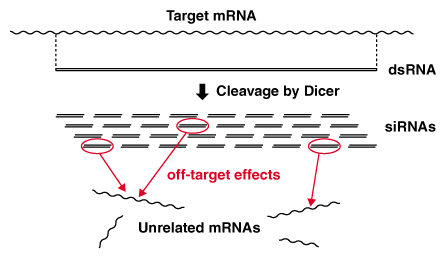 Examples
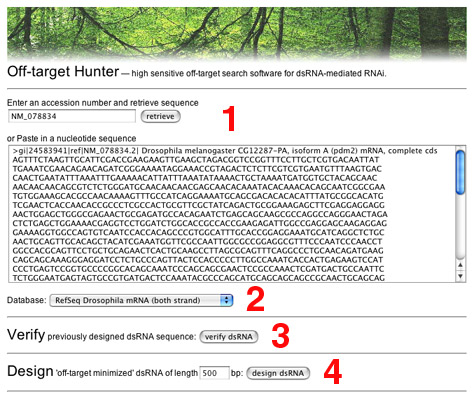 Verify previously designed dsRNA sequences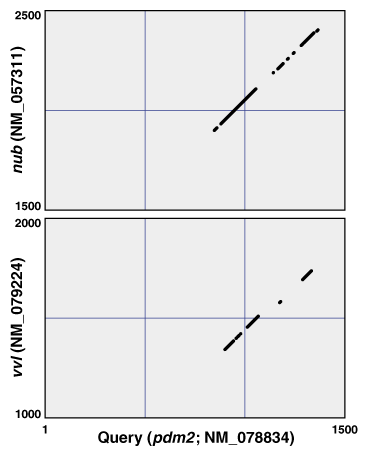 Design 'off-target minimized' dsRNAWhy 19 nt?Since 19-nt duplex region of an siRNA is mainly involved in the target mRNA recognition, we set 19 for the default dicing size. ReferencesCreditsYuki Naito, Tomoyuki Yamada, Sabumaro Matsumiya, Shinichi Morishita, Kumiko Ui-Tei and Kaoru Saigo used the expertise of biology and informatics, and designed the system. This work was supported in part by Special Coordination Fund for Promoting Science and Technology to Kaoru Saigo, grants from the Ministry of Education, Culture, Sports, Science and Technology of Japan to Kaoru Saigo and Kumiko Ui-Tei, and Grant-in-Aid for Scientific Research on Priority Areas and Leading Project for Biosimulation, the Ministry of Education, Culture, Sports, Science and Technology of Japan to Shinichi Morishita. |
Last modified on Feb 5, 2005